Kraken vs. Gemini vs. CEX.IO
Kraken, Gemini, and CEX.IO are among the most popular Bitcoin exchanges, and, generally speaking, you can not go wrong no matter which one you pick. However, each serves different types of crypto users. Some focus more on advanced trading tools, others emphasize regulation, while some prioritize direct fiat access and structured fees.
In this guide, we'll compare some of the most renowned crypto exchanges side by side to help you choose the platform that fits your needs.

Kraken vs. Gemini vs. CEX.IO: Key Differences Compared
If you prefer a quick overview before diving deeper, the table below highlights the key differences in cryptocurrency listings, fees, staking features, U.S. availability, and regulatory structures.
Feature | CEX.IO | Kraken | Gemini |
| Cryptocurrencies Listed | 325 | 300+ | 300+ |
| Instant Buy Fees | Card deposits 0.49%–4.99% + service charge (varies by method) | 1% + spread | 1.49% + 1.00% convenience fee |
| Spot Trading Fees (Starting) | 0.25% | 0.20% maker / 0.40% taker (Pro) | 0.20% maker / 0.40% taker (ActiveTrader) |
| Lowest Spot Tier | 0.10% | Volume-based reductions | Volume-based reductions |
| Staking / Earn | Staking + Flexible & Locked Savings | Flexible + bonded staking, ETH restaking, BTC staking | ETH, SOL, MON staking |
| U.S. Availability | Yes | Yes | Yes |
| Regulation & Oversight | U.S. registrations + EU compliance; PCI DSS certified | Multiple U.S., UK, EU registrations; proof-of-reserves | NY Trust Company; SOC 1 & SOC 2; ISO 27001 |
What Is CEX.IO and How Does It Work?
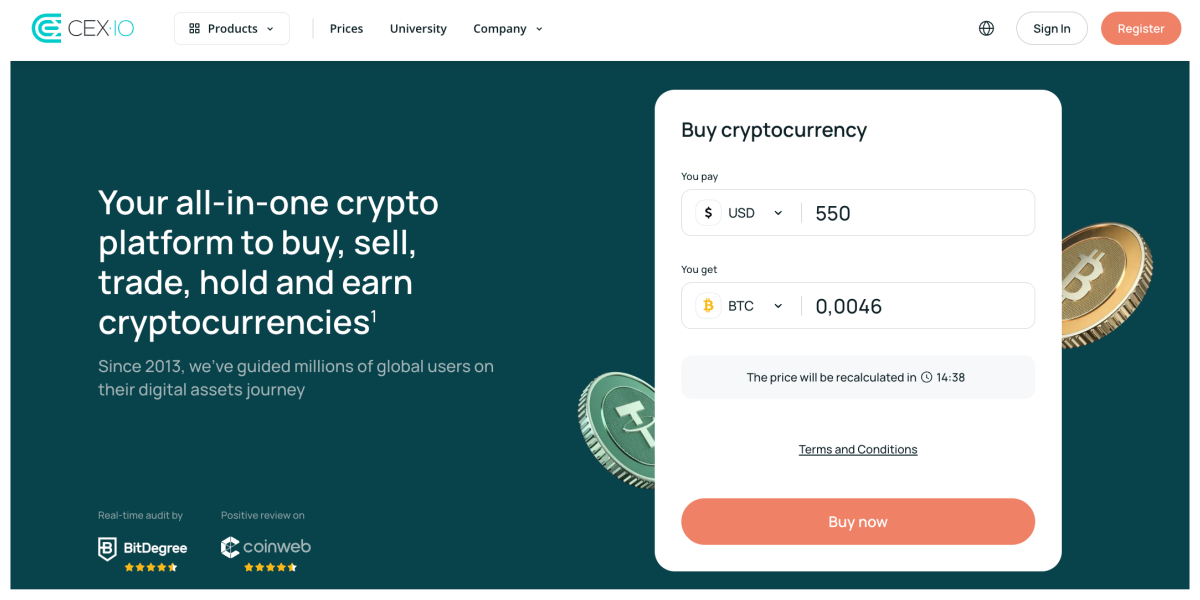
Founded in 2013, CEX.IO operates as a multi-service crypto platform that integrates card payments, bank transfers, spot trading, staking, and institutional liquidity into a single account, so you don't need to install additional software or use third-party tools.
Once you register and verify your identity, you can either buy crypto directly through Instant Buy using your credit/debit card or mobile wallets like Google Pay, Apple Pay, or PayPal (available to U.S.-based customers only) or fund your account with fiat via bank transfer (SEPA, SWIFT, Faster Payments, ACH). Then, you can choose between Spot Trading, Savings, Staking, or API trading. Spot fees start at 0.25% and decrease to 0.10% once 30-day volume exceeds $20 million.
CEX.IO focuses heavily on direct fiat access, multiple payment rails, and structured fee tiers rather than relying primarily on spread-based pricing, which we will dig into more below in our detailed Gemini vs. CEX. IO vs.Kraken comparison.
Why do Users Like CEX.IO?
Users often highlight how quickly they can trade Bitcoin and other assets without switching between separate products, and we had the same experience while testing. After verification, you can buy BTC with Visa, Mastercard, ACH, SEPA, or SWIFT (depending on your country) from the same dashboard you use for spot trading.
The free CEX.IO Wallet comes built into the account. You store, convert, stake, or transfer funds without paying custody fees. It's available through both CEX.IO's web-based client and crypto mobile app, with very few differences in design, which should help you navigate if you prefer to switch between devices. CEX.IO Pay comes included in your wallet and allows zero-fee transfers between verified users, which can come in pretty handy if you like to work with your fellow traders.
The cryptocurrency prices list updates in real time and links directly to trading pairs, order books, and market depth. During testing, we found the list easier to scroll through and visually cleaner than on some competing platforms. Prices, percentage changes, and pairs sit in a straightforward layout without clutter, which can help beginners scan the market faster and move from tracking to execution in one click.
Get crypto with your debit or credit card.
Start your crypto journey today with ease. Buy top cryptocurrencies using your debit or credit card and gain instant access to the world of digital assets.

What Is Kraken and How Does It Work?
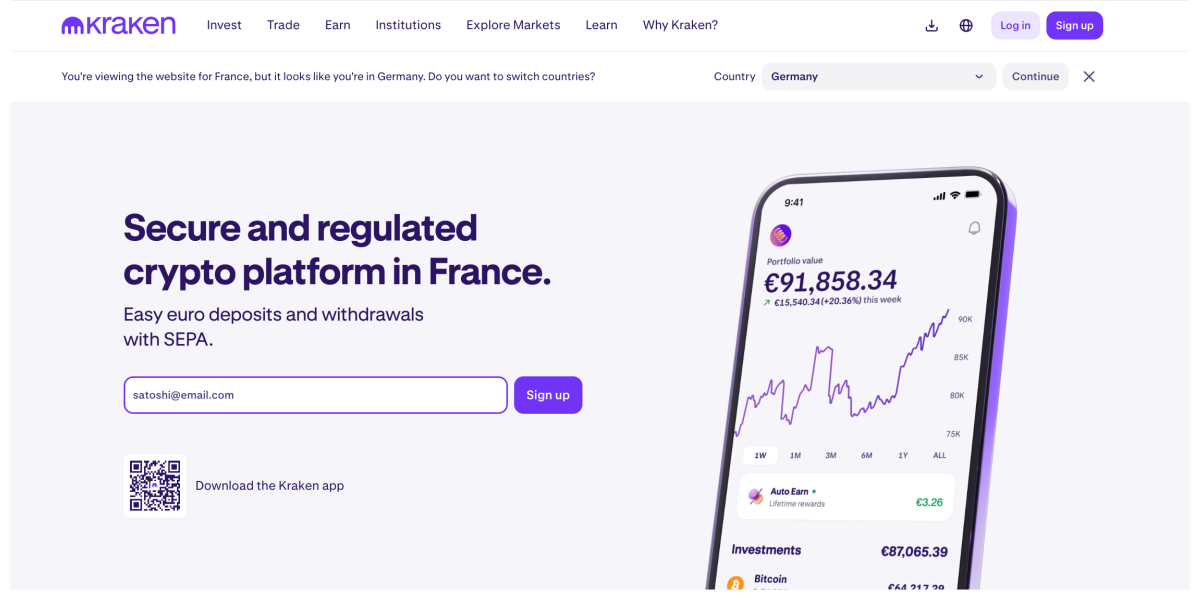
Kraken started in 2011 and built its identity around active trading. The platform centers heavily on spot markets, margin access, and derivatives. After creating and verifying your account, you can fund it with fiat or crypto and trade through either the simplified Kraken app or Kraken Pro.
You can acquire crypto through Instant Buy, which applies a 1% trading fee plus spread. If you intend to trade on Kraken, keep in mind that Kraken Pro uses a maker–taker structure starting at 0.20% maker and 0.40% taker, with lower tiers available as volume increases. The overall setup favors traders who want direct access to order books and advanced execution tools, but more on that in later sections.
What Is Gemini and How Does It Work?
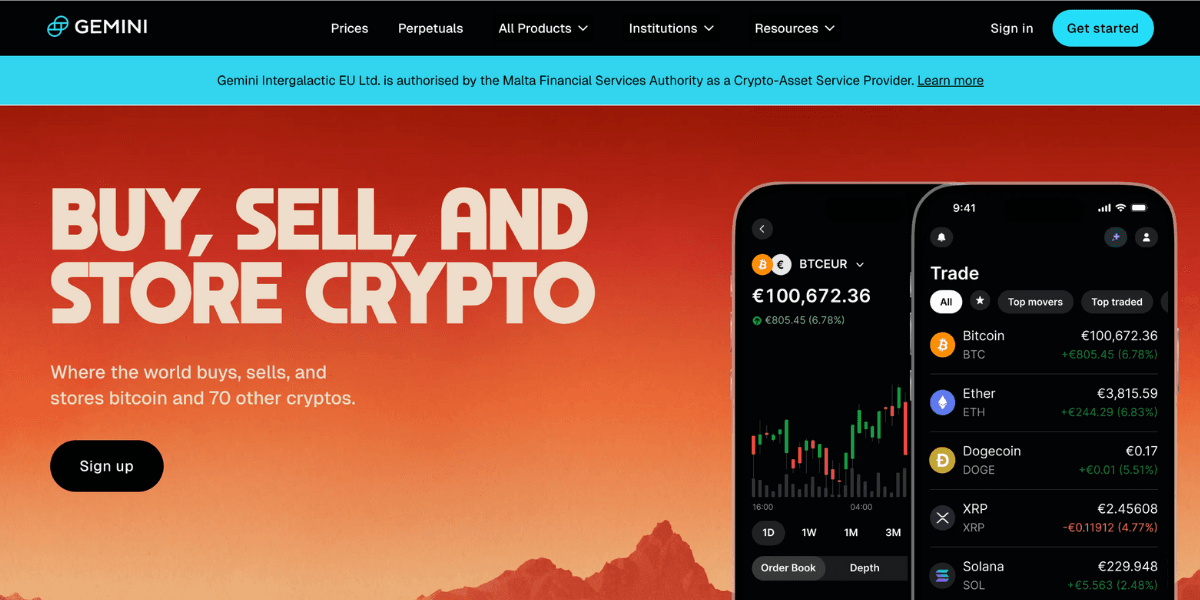
Gemini launched in 2014 in New York and operates under a New York trust framework. It offers both crypto exchange and custodian services, meaning it handles trading and asset storage within the same regulated entity.
After completing identity verification, you can fund your account with fiat or crypto and access two trading environments. The standard interface focuses on quick purchases and portfolio management, while ActiveTrader provides full access to the order book, charting tools, and advanced order types.
Beyond trading, Gemini offers staking for selected assets and tokenized stocks in certain regions.
Head-to-Head Comparison: Kraken vs. Gemini vs. CEX.IO
All three platforms target slightly different types of users. In this section, we compare Kraken, Gemini, and CEX.IO side by side in terms of ease of use, supported cryptocurrencies, mobile experience, security, fees, and advanced tools.
We tested each exchange directly and walked through the same flows, account setup, funding, trading, staking, and withdrawals. Our goal is to show you where each platform stands so you can decide which one fits your trading style, experience level, and priorities. So, let's dig in.
User Interface
You'll find many similarities, or at least little to no differences, between Kraken's and Gemini's approach to visual appearance. As mentioned earlier, both platforms separate their experience into two clear environments, aiming to create a more user-friendly, logical structure.
There's a default interface with quick buys and access to portfolio management, while more advanced terminals, called Pro in Kraken and Active Trading in Gemini, offer detailed charts, order books, and additional order types, which beginners may find a bit overwhelming once they leave the basic view.
CEX.IO, on the other hand, keeps Instant Buy, wallet management, and Spot Trading under one consistent design system. You can switch between funding, trading, and staking without entering a completely different interface, which could make moving between tasks smoother and more intuitive, especially for beginners just starting to grasp the world of crypto.
Fees
When comparing Kraken vs. Gemini fees, the structure looks similar at first glance, but the real difference shows up in how each platform prices convenience versus order-book trading.
Kraken's Instant Buy applies a 1% trading fee plus spread. If you move to Kraken Pro, fees start at 0.20% maker and 0.40% taker, decreasing as your 30-day volume increases. That means casual users pay a flat 1% plus spread, while active traders reduce costs by placing limit orders.
Gemini separates its pricing more clearly. Instant and Recurring orders charge a 1.49% transaction fee plus a 1.00% convenience fee. This means Gemini builds the 1.00% convenience component into the quoted price and then adds the 1.49% transaction fee at execution. That results in roughly 2.49% in listed fees before any price movement adjustment of up to 2.00% on the convenience component. ActiveTrader avoids this structure and starts at 0.20% maker and 0.40% taker, scaling down with volume.
CEX.IO uses a straightforward spot tier starting at 0.25% and decreasing to 0.10% above $20 million in 30-day volume. Users who fund with cards should account for 0.49% to 4.99% plus service charges, depending on the provider and region. For traders who place limit orders regularly, the tiered spot model keeps costs predictable and easier to follow. You pay the stated spot fee based on your 30-day volume, rather than a transaction fee plus an additional convenience percentage added to the quoted price.
Cryptocurrencies
When comparing cryptocurrency listings, the differences are narrower than they may first appear. Kraken and Gemini each support 300+ assets globally, while CEX.IO currently lists 325. Because exchanges regularly add or remove tokens, comparing them by raw numbers is irrelevant.
If you mostly trade well-known coins like Bitcoin or Ethereum, the difference between 300 and 325 listings probably won't affect you much. The extra tokens usually sit in the smaller, less popular category, which many traders never touch.
Mobile App
All three exchanges provide iOS and Android apps, but you can quickly notice how the structure of each exchange app differs once you start using them daily.
Like with its desktop platform, Kraken separates its mobile experience into two apps: the standard Kraken app for instant buys and portfolio tracking, and Kraken Pro. Active traders usually stay focused on the Pro environment, but users often switch between apps depending on what they need.
Gemini does things a bit differently here, keeping everything in one app. You toggle between the default interface and ActiveTrader mode, which activates TradingView charts and order-book access without requiring a separate download.
CEX.IO App mirrors its web platform closely inside the mobile app, which should make your life easier if you toggle between devices. Instant Buy, Spot Trading, wallet balances, and the CEX.IO Earn program (Staking and Savings) sit within the same structure. You can fund your account, place trades, and manage rewards without changing apps (there's no separate platform for purchasing and trading) or switching to a different environment.
Security
Each platform follows a different regulatory structure, which affects how it stores customer funds, conducts audits, and operates across various regions.
Gemini operates as a New York trust company under the supervision of the New York State Department of Financial Services. It holds SOC 1 Type 2 and SOC 2 Type 2 certifications, ISO/IEC 27001:2022 certification, and states that it maintains full-reserve custody, meaning customer assets remain held 1:1 and segregated from company funds. Gemini also requires multi-factor authentication for logins and withdrawals.
Kraken holds multiple registrations across the U.S., U.K., Canada, and parts of Europe. It implements proof-of-reserves audits and supports hardware security key login, 2FA, and granular API permissions. However, its regulatory structure differs by entity and region, so available protections depend on jurisdiction.
CEX.IO operates through several licensed entities, including U.S. registrations and European compliance frameworks. The platform maintains PCI DSS certification for card data security and enforces AML/KYC verification standards. It separates client funds and provides two-factor authentication, device management, and controls for withdrawal confirmation.
Advanced Features
Kraken provides one of the broadest advanced toolsets. Traders access margin trading, perpetual futures with 0.25% open and close fees, bonded and flexible staking, ETH restaking via EigenLayer, and BTC staking through Babylon. API access supports algorithmic strategies, and Kraken Pro includes detailed order types and depth tools. These are all great for seasoned traders, while beginners might find its wide library of tools a bit overkill.
Gemini focuses on ActiveTrader, API trading, staking for ETH, SOL, and MON, and tokenized stocks in the EU, though its derivatives exposure remains more limited than Kraken's.
CEX.IO concentrates more on integrated fiat access and yield products than high-leverage derivatives. It offers spot trading with tiered fees, staking and savings products, CEDEX Web3 swaps with gas coverage after the first transaction, and institutional liquidity through CEX.IO Prime. You also get a structured API access, which allows automated trading strategies, custom order execution, and direct integration with trading bots or institutional systems without relying on the web interface.
Our Verdict: Gemini vs. Kraken vs. CEX.IO
When looking at Gemini vs. Kraken vs. CEX.IO, the right choice depends on how you plan to use the platform.
Kraken makes sense if you trade actively and want access to perpetual futures, margin, and advanced order controls. It gives experienced traders more room to work with detailed tools and volume-based fee reductions.
Gemini fits users who care strongly about regulatory structure and formal oversight. Its New York trust status and audit framework provide a clear compliance foundation.
CEX.IO works well if you prefer straightforward fiat deposits, structured spot fee tiers, staking and savings in one place, and a platform that keeps buying, trading, and wallet management under the same layout.
Each exchange performs well, but the best fit depends on your trading style, experience, and priorities.
Buy crypto instantly
Buy Bitcoin, Ethereum and other top cryptocurrencies securely with your debit or credit card. Fast purchases, low fees, easy withdrawals.

FAQ
Is Gemini, CEX.IO, or Kraken better for beginners?
For beginners, CEX.IO often feels easier to start with. You can fund your account directly with Visa, Mastercard, ACH, or SEPA and buy crypto from the same screen you use to manage your wallet. The layout remains consistent across web and mobile, reducing confusion when you make your first trades.
Which exchange has lower fees?
If you trade larger volumes on the spot market, CEX.IO can offer the lowest rates among the three. Its spot fees start at 0.25% and drop gradually, reaching 0.10% once your 30-day trading volume exceeds $20 million. That tier makes CEX.IO particularly attractive for active spot traders who consistently place higher-volume orders.
Which exchange offers more cryptocurrencies?
Among the three, CEX.IO lists the highest number, with 325 cryptocurrencies on its spot market. Kraken and Gemini both support 300+ assets globally, though availability can vary by region and product type. If you're comparing strictly by total spot listings, CEX.IO currently has the edge in overall count.
What crypto app is better than Gemini?
CEX.IO can be a better choice if you want everything in one place. The app offers card funding, spot trading, staking, savings, and wallet management in a single layout. You don't need to switch into a separate advanced mode, which makes daily use feel simpler and more direct.
What is the minimum deposit for CEX.IO?
The minimum deposit on CEX.IO depends on the payment method. For most card deposits, the minimum starts at $20. ACH deposits also begin at $20, while SEPA and Faster Payments start at €20 or £20. SWIFT transfers typically require a higher minimum, starting at $300.
How to choose the right Gemini alternative?
To find the best Gemini alternative, start by defining what matters most to you. Compare fee structures for instant buys versus order-book trading, check supported cryptocurrencies in your region, review funding methods, and evaluate advanced tools like staking or derivatives.
What is the safest crypto exchange?
CEX.IO stands out because it operates through licensed entities in the U.S. and Europe, follows strict AML/KYC standards, and maintains PCI DSS certification for card security. The platform separates client funds, enforces two-factor authentication, device management, and withdrawal confirmations. For users who rely on fiat deposits and card payments, that structured compliance and payment security framework adds an extra layer of protection.
Who are the top competing crypto projects to Gemini?
CEX.IO is one of Gemini's strongest competitors. It competes directly in spot trading, staking, and fiat on-ramps, while also offering card funding, ACH, SEPA, SWIFT transfers, and structured fee tiers starting at 0.25% and decreasing to 0.10% at higher volumes.
Is CEX.IO available in the U.S.?
Yes, CEX.IO is available in the United States through its U.S.-registered entity. The platform holds money transmitter registrations in multiple states and follows AML/KYC compliance standards. U.S.-based users can access spot trading, card deposits starting at $20, ACH transfers, and staking services, subject to state-level restrictions.